


Since President Trump took office for the second time in Jan. 2025, global leaders and the finance world have been trying to catch up with the fast-moving administration.
With reciprocal tariffs being imposed, many countries are finding it difficult to come to terms with getting treated the way they were dishing out, with some even retaliating in their own way.
And no, I am not talking about the nasty bickering between the US and Canada. Something major is happening in Japan, which is going under the radar akin to the majority of Japanese monetary policies.
Tariffs on EVs are threatening global financial markets. The US threatened Japan with 25% tariffs on its EV cars, which could be a massive blow to the Japanese economy. Nearly 9% of Japan’s workforce is employed in the automobile industry, which accounts for nearly 14% of its manufacturing GDP.
Tariffs have threatened the dragon and it is ready to fire back.
“Given the economic balance, it is in our national interest to diversify our investment,” the Japanese Ministry of Finance said in a statement on March 1.
And the Japanese put their money where their mouth is by selling US Treasuries.
The dragon country huffing fire
As of December 2024, the Bank of Japan held nearly $1.07 trillion worth of US T-bills, down from $1.1 trillion in December 2023. At its peak in November 2021, the BoJ held $1.3 trillion worth of US bonds, with the Asian central bank holding nearly 15 percent of all foreign-held US debt.
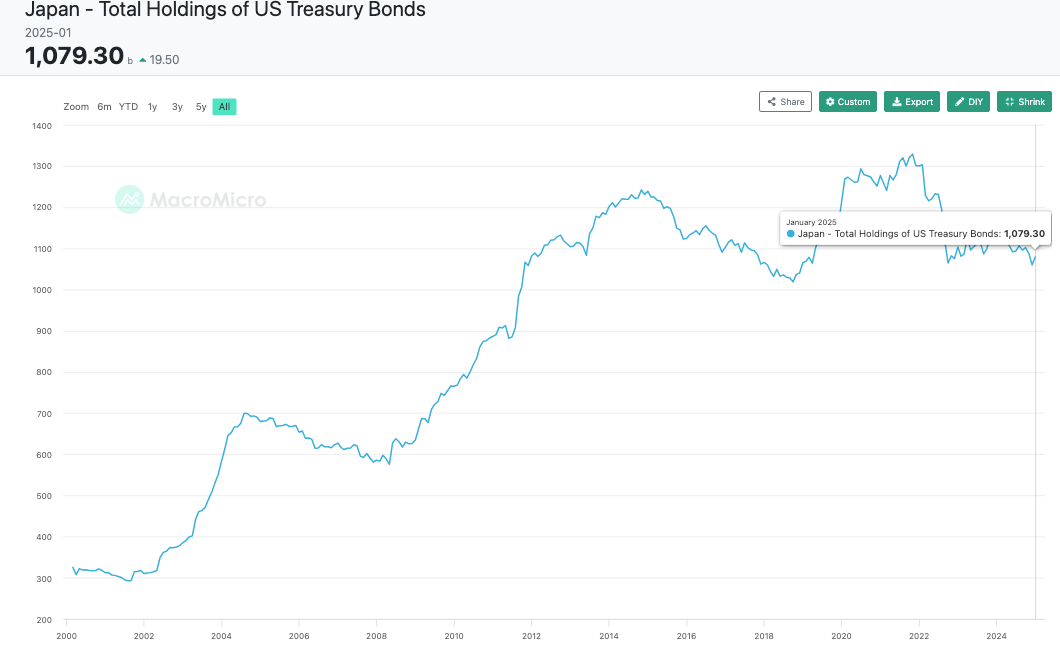
This is important because Tokyo is arguably the biggest foreign buyer of US debt. In recent years, however, the BoJ has been cashing in on its holdings to shore up the Yen.
In the last five years, the yen has weakened against the dollar by nearly 40% and if not for the BoJ interventions from time to time, the picture would have been much worse.
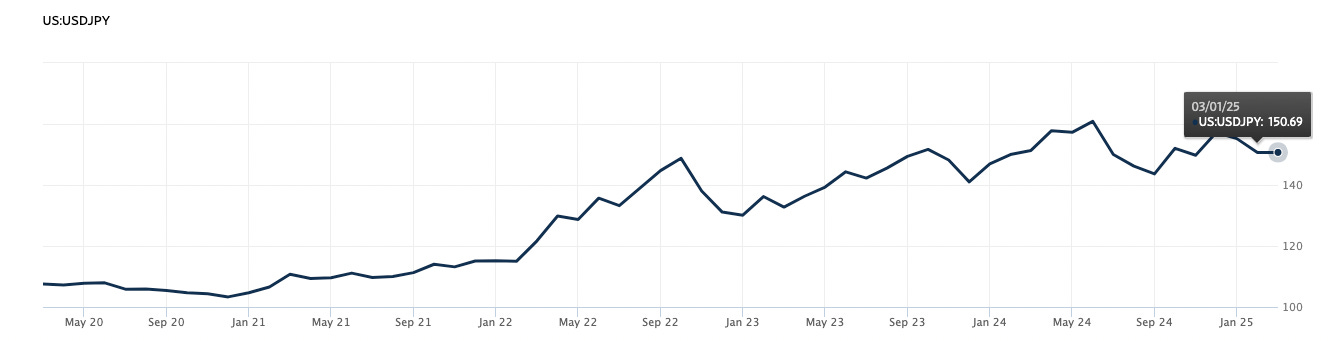
Last August, when BoJ hiked rates by a measly 25 bps, the US equity markets wiped out close to $3.5 trillion in two trading days.
What forced the BoJ’s to bite the hand that feeds it - weakening of the Yen and sticky inflation. The idea was simple- sell US T-bills, and use the cash to buy the yen to support it from further deterioration.
What happened though? A big chunk of US equities that global investors were speculating on by borrowing cheaply in Japan thanks to ultra-low interest rates had to liquidate their longs and rush back with their capital to Tokyo to pay on their floating interest rate credit.
But what happens when Japan puts a fire sale on its US T-bills to save its own economy and is it happening right now?
The answer is it would be catastrophic to the US Treasury market not only because many bondholders will finally realize how much unrealized losses they are sitting on, but they will also lose one of a kind of ‘primary subscriber.’ And yes, it is happening right now, but in a much-controlled manner.
A slow move away from the dollar rather than pulling the plug quickly.
Washington DC is aware of it and does not like the harsh reaction of its eastern ally.
Treasury Secretary Scott Bessent even said in a brief public statement this month that trust between allies is essential and interdependence makes sudden moves by one side risky.
Rome wasn’t built in a day, neither did it wither in one
Japan is one of the few economies that can undermine the USD’s prestige in the world and it is following a major global south trajectory to ditch the dollar.
President Trump who I believe is good at understanding major trends, picked the de-dollarization trend long before he even stepped into the Oval Office, tweeting on his Truth social media platform that he will impose 100% tariffs on countries that are pivoting away from the dollar.
But that is easy to do if it's a handful amount of nations that have limited trading relationships with the US, but a lot more difficult when all major economies are making the pivot.
Many nations have already moved with Russia and China settling nearly 100% of trade between them in rubbles and yuan.
India also started making global payments in rupees and the biggest shock came when Saudi Arabia, the king of the petrodollar refused to renew its petro-dollar trading deal last year, and registered interest in settling oil trades in other currencies like the yuan and rupees.
Even Kenya has moved to buy oil from the Gulf region in Kenyan shillings last year with their President William Ruto even urging Africa to dump the dollar in 2023.
With countries inching away from the greenback, the dollar’s share of global reserves has fallen from more than 70% in 2000 to 59% in 2024, according to Brooking’s Institute’s Aug. 2024 report.
The dollar will not be challenged head-on but might suffer death by a thousand cuts.
So who replaces the mighty USD?
While many countries have been slyly pushing for their currency to replace the dollar, but it won't be possible, because the US has something that no one else does - The Federal Reserve.
No nation can provide a stable exchange value coupled with infinite liquidity, powers that only the US Fed possesses.
So de-dollarization experts came up with an alternative, why not revert to basics - a gold-backed currency system.
According to a JPMorgan Aug. 2024 report, central banks across the globe are stockpiling gold in anticipation of a currency crisis. The Public Bank of China, the Reserve Bank of India, and the Federal Reserve were major gold buyers of 2024.
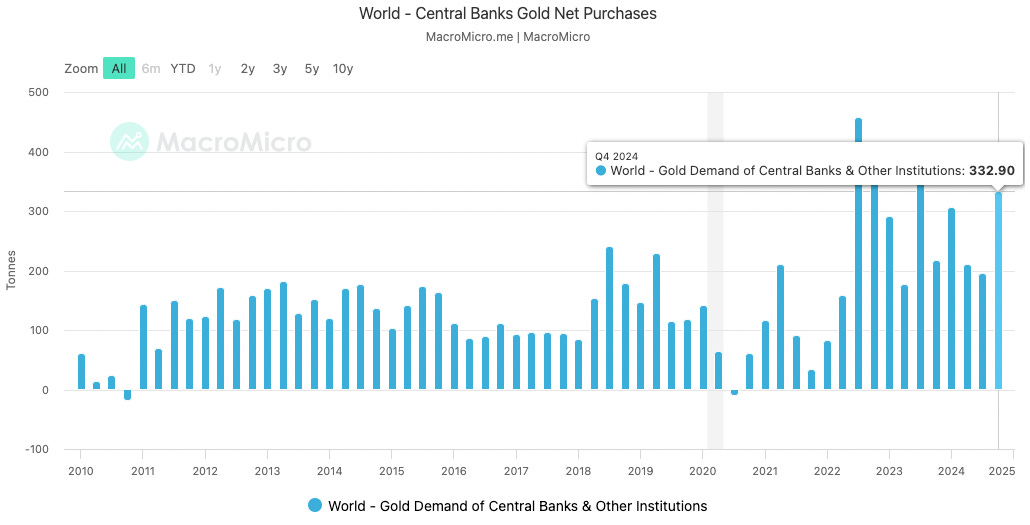
In Q4 2024, central bank net gold purchases were 332 tonnes, compared to 117 tonnes in Q4 2019, an increase of 183% over five years.
Gold prices have surged since 2020 hitting an all-time high of $3,057 last week.
It does make sense that nations would want to peg their currencies to gold rather than relying on the USD, but unless a major global credit event or a massive downturn in the US economy is felt or a currency crisis hits the global financial markets, the dollar will be the undisputed king.